
Édouard Manet, How the Imitation of the Masters Forged Modern Art
- Art d'Histoire
- May 28
- 4 min read

In the 1860s, the French school was scandalised by the paintings of a new school, the so-called Batignolles school, whose leader was Édouard Manet.
Yet, behind this reputation as a revolutionary lay an admirer of the Old Masters, a fact often ignored by the critics of his time, whether they were hostile or favourable to him.
Critical Denial
In his early days in the 1860s, contemporary observers of the painter noticed similarities between his canvases and the classical repertoire.
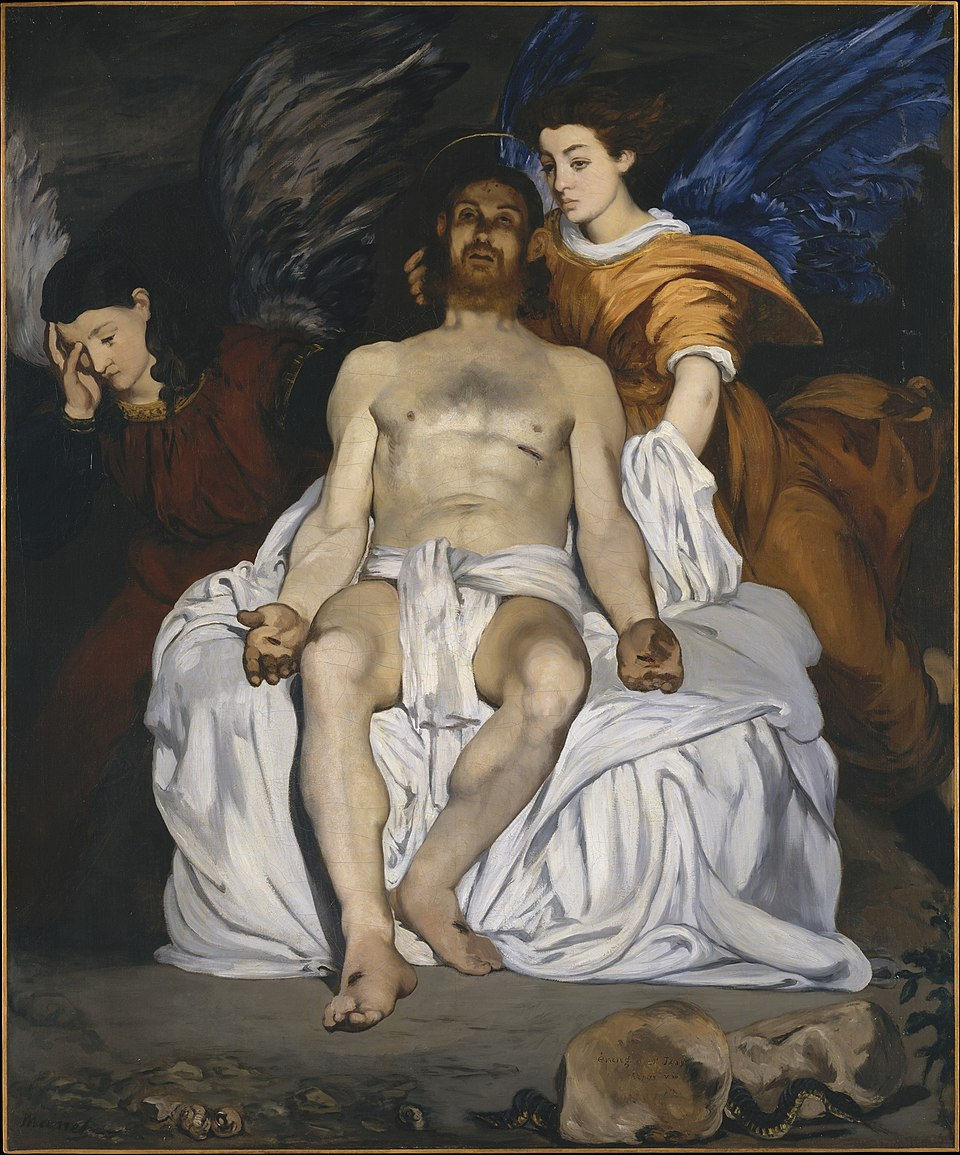
The historian Théophile Thoré identified references to El Greco, Peter Paul Rubens, and Annibale Carracci in the Dead Christ with Angels exhibited at the Salon in 1864. Even Gustave Courbet, visiting Manet's solo exhibition at the Alma, noted with astonishment the influence of the Spanish masters on the compositions.
Curiously, however, when Olympia was exhibited in 1865, only one critic (Cantaloube, and a certain Pierrot who might well be that same Cantaloube) dared to formulate a direct parallel between the sulfurous Olympia and Titian's famous and respectable Venus of Urbino. It seemed that the perceived vulgarity of Manet's nude could no longer be compared to the Italian Venus, even though the compositions were identical—Manet, moreover, had made a copy of the Italian painting in his youth. Manet's disrespect for many academic norms made the very idea of a lineage impossible.
These observations were quickly downplayed by the artist's own circle of supporters. Manet was conceived as a leader of the avant-garde, in rupture with, rather than in continuity with, the past. A concealment strategy was put in place.

At the end of the century, his biographer Théodore Duret asserted that the artist felt a profound aversion to traditional art; it is true that Manet himself said he abhorred history painting, which sat at the very top of the hierarchy of genres... which does not mean that he despised the Old Masters.
Authority figures such as Louis Hourticq or Jacques-Émile Blanche finally attempted to justify Manet's borrowings from the masters, claiming that the painter always ended up forgetting his models when he found himself observing nature. The accidental borrowing of his early days was thus relegated to the rank of temporary clumsiness, the time it took to train and find his way.
The 1932 Revision: Borrowing to Forget the Subject and Concentrate on Form Alone
It was not until a major retrospective organised at the Musée de l'Orangerie in 1932 that a decisive turning point occurred.
The historian Germain Bazin published research revealing that the painter did indeed draw unreservedly from the masters.

The listed lineages are vast and precise. Le Déjeuner sur l'herbe (1863) takes the postures from Raphael's Judgment of Paris engraved by Marcantonio Raimondi. The Surprised Nymph (1861) is inspired by Rembrandt's figure of Susanna and the Elders, while The Boy with a Dog (1860) directly echoes a work by Bartolomé Esteban Murillo. Documentary sources also demonstrate that The Dead Man (1864) mirrors a soldier attributed to Diego Velázquez, and that religious works such as The Dead Christ with Angels appropriate engravings by Gaspard Duchange after Veronese.

According to Bazin, this approach was not the result of a creative deficiency. In reality, he proposed, by delegating the spatial arrangement and the choice of subject to the Old Masters, the painter relieved himself of narrative and compositional constraints to devote himself exclusively to the question of form—colour, matter, and touch. The artist thus inaugurated what historians would call an ontological approach to painting, a practice concerned with its own material essence rather than the illustration of a fiction—a theory that Clement Greenberg would develop in the following decade.
The Classical Masters, Pillars of Manet's Modernity
In 1969 in Artforum, Michael Fried—who was close to Greenberg in his younger years—published a lengthy study and enumerated the artist's borrowings from masters such as Goya, Van Dyck, Rubens, Giorgione, Watteau, or Chardin, to name but a few.
His research definitively discarded the hypothesis of a palliative imitation aimed at masking technical defects. The painter openly appropriated the art of the past to confront it and reinvestigate formal problems, particularly that of the relationship between a work and the spectator. Fried became fascinated, after Diderot, by the introspective or "theatrical" aspect of painting and placed the study of the relationship between Manet and the masters in this perspective.


Alain de Leiris's research on The Old Musician follows this vein. The composition brings together in the same figure a posture derived from Hellenistic statuary and the features of a Gypsy well known to painters and the Parisian suburbs. Watteau and the Le Nain brothers are also present in this Old Musician; the modern artist works in continuity with his predecessors.
Hellenistic era of Chrysippus, 1st century
One can then restudy the harsh words addressed by Charles Baudelaire to Édouard Manet:
"you are only the first in the decrepitude of your art."
An ambiguous reflection by the poet studied in our lecture on Olympia, available via open access on YouTube and on our site.
This blog relies on the primary source anthology sheets provided by Art d’Histoire Académie:
Plus all those inserted as links in the blog above
You can also view our traditional, free-access videos:
The Art d’Histoire Académie platform specialises in primary sources and digitised archives covering the artistic period from 1850 to 1910.
It offers clear, structured interactive videos accompanied by a library of over a thousand anthology sheets, comprising 10,000 explained and contextualised primary sources that can be viewed in their original format.
Whether you are preparing for an exam, a lecture, a guided tour, a conference, an exhibition, or a publication, Art d’Histoire Académie is here to support you. The labyrinth of archives simply becomes what it ought to be for any passionate researcher: a source of inspiration and a space for fulfilment.


