
The Portraits
As much a salon-goer and critic as a poet, Baudelaire offers a theoretical framework for artistic modernity. Baudelaire posits modernity in literature and painting as the product of an artist who is part rag-picker, part alchemist. According to Walter Benjamin, the Baudelairean artist collects the refuse of modern life and transforms it into modern art by passing it through the alembic of their imagination. This theory is particularly relevant to the study of Édouard Manet's paintings. In addition to these theoretical elements, there are a few colourful anecdotes.

A scientific vision of modern literature. Zola entered the literary world through journalism, writing art reviews that were later published in the collections Mes Haines and Mon Salon. In these texts, he championed modern art, particularly the work of Édouard Manet, defying the academic norms he despised. Zola may have recognised a similarity between the painter's approach and his own method: both used an almost scientific description of observed facts as raw material for their work.

To what extent do modern writers portray reality without distorting it? To ensure maximum neutrality, authors of this generation attempted absence, non-intervention and impersonalisation. It was as if the narrative structure, the characters as well as their destinies were ruled by an implacable, external logic, rather than the imaginative fantasy of their creators.

A secretive but influential man. Georges Seurat was nicknamed 'the notary' by Degas, probably because of his meticulous nature. Coming from a wealthy background, he was free from financial constraints and able to devote himself to studying new artistic forms without any immediate commercial goals. A discreet bookworm, he was offended by Gauguin's admission to Signac's studio, given Gauguin's reputation for appropriating other artists' ideas. This incident may have contributed to Gauguin's subsequent hatred of Divisionism.

His image as a modernist pioneer suggests indifference to the subject. But is this really the case? In 1886, the inventor of Divisionism entered the history of Modernism by exhibiting A Sunday Afternoon on the Island of La Grande Jatte. Was he merely depicting the joyful, light-hearted nature of Sunday strollers? Does his painting conceal a political message? Or is the subject of no importance to him? Was he interested only in form? These are just some of the contradictory views put forward by historians from diverse intellectual backgrounds.

_edited_edite.jpg)
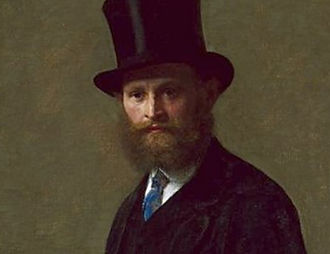
The painter was both a bourgeois and a republican, a lover of society and certainly not a bohemian. The life of one of the fathers of modernity is full of anecdotes that enrich our understanding of his art. Contrary to the image of the bohemian painter portrayed by critics and the public — who, incidentally, sometimes confused him with his near-namesake, Claude Monet — Manet was, in fact, a bourgeois, republican gentleman who was prepared to defend his honour or that of his sister-in-law in a duel.
Manet is widely regarded as the leader of the Impressionist movement. However, Édouard Manet never participated in the founding exhibitions of the Impressionist movement. His style was both in line with the great masters whilst still being revolutionary. He developed a form of realism that was defended by a young, at the time unknown writer named Émile Zola. This style broke with tradition while paying homage to it. The story of Olympia's late entry into the Louvre, following a subscription campaign, reminds us how long and painful the process of official recognition was.

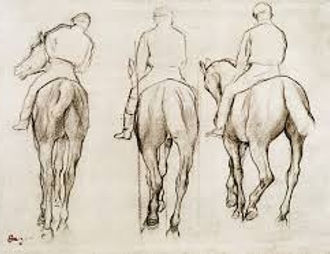
The painter preferred to work in his studio, either from memory or from a little mock-up. A founding member of the Impressionist exhibitions, Degas advocated an inclusive recruitment policy, incorporating more conventional painters. A great draughtsman himself, he followed in the tradition of Jean-Dominique Ingres, the master of line, and trained in Italy in the tradition of the Renaissance masters. Contrary to the popular perception of Impressionist painters, Degas openly expressed his dislike of plein air painting.
Monet's turbulent life is often romanticised. Born into a provincial bourgeois family, he did not live up to his father's ambitions. This led to financial difficulties which consequently drove Monet to attempt suicide. Things finally turned around when he eventually married with his father's blessing and exiled himself to London, where he met his future dealer, Paul Durand-Ruel. Durand-Ruel was willing to support the painter, who loved to paint outdoors — much to the chagrin of the older Gustave Courbet.

Art history has traditionally romanticised the figure and technique of the master of Impressionism. Any reputable history of Impressionism will state that the painting Impression, Sunrise gave its name to the movement. However, while this information is accurate, it is difficult to determine which painting was exhibited under this title. One possibility is a painting held in the Californian collection of the Getty Museum. As success is often accompanied by mythologisation and institutionalisation, it is useful to reconsider certain misleading ideas.

His life was filled with colourful events and immortalised through caricatures. Courbet was generous by nature, yet he could end a friendship if it did not satisfy his artistic needs. Then there are the colourful anecdotes: the angels' behinds; the bottoms of his bathers whipped by the Emperor; and the bon vivant caricatures recognisable by their enormous bellies, acquired through beer, wine and good food — a condition that would ultimately cost Courbet his life.

Anecdotes and caricatures reveal an artist who knew how to promote and display his work. Over the years, Gustave Courbet developed a keen sense for the value of his own art. This enabled him to successfully manage his own commercial promotion, negotiate on equal terms with his patron, Alfred Bruyat, as well as Émile de Nieuwerkerke — Napoleon III's superintendent of fine arts — and open his own salon opposite the buildings of the Universal Exhibition. He even publicly refused the Legion of Honour. By nature, Courbet was overly self-satisfied and caricaturists relished immortalising this side of him.

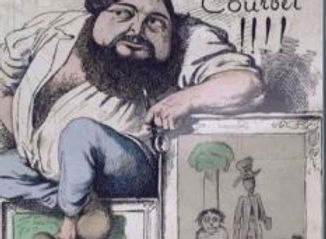
The painter from Franche-Comté intended to create art of the people, but certainly not for the people. Although caricatures depicted him as a working-class painter, Gustave Courbet was a great master, and his clients were from the upper class who could afford his fees. Opposed to any jury’s obstruction that hindered his ability to connect with the public, from 1855 onwards in parallel to the Salon, he chose to manage his own exhibitions if needed; a sense of self-promotion that would encourage Manet and the Impressionists to take charge of their own showcases.
The painter naively embarked on a political career by joining the Communards. This political choice came at a high price for Courbet. Elected to represent the 6th arrondissement of Paris, he organised the Federation of Artists and chaired the Commission of Monuments, whose remit was to protect Paris and its museums — hence the caricatures. Enthusiastic and spontaneous, he encouraged the dismantling of the Vendôme Column. After the Versaillais' victory, he was held responsible for its destruction, fined a huge amount and consequently fled to Switzerland.

Depending on the circumstances, the man presented himself as noble, Indian or primitive, revealing his very nature as a mystifier that invites deconstruction. New generations of historians enjoy dismantling the mythical figure of the brilliant exiled artist who presented himself as a savage. Gauguin lends himself to this exercise: behind his apparent 'primitivism', he retained the habits of a white man in a French colony. However, deconstruction can sometimes obscure the truth about this whimsical painter and adventurer who refused to embrace the Parisian bohemia.

There are many anecdotes about his propensity for quarrelling and his constant desire to outdo others. Shortly before her death, his mother voiced her concerns about his future, given his unfriendly and quarrelsome nature. One after the other, he fell out with Pissarro, Seurat and the Divisionists, his old friend Schuffenecker as well as his guardian Arosa and his wife Mette. These anecdotes provide insight into the man behind the myths. His relationship with Vincent van Gogh is not discussed here, as this was the subject of the lecture 'Gauguin versus Van Gogh'.

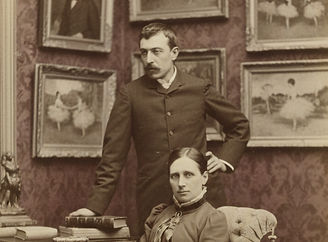
Working as a stockbroker in the Paris Stock Exchange enabled him to amass a vast collection of Impressionist paintings. The presence of so many Impressionist paintings in Danish museum collections may be surprising. This is thanks to Gauguin's intuition. While he was still working at the Paris Stock Exchange and pursuing his passion for painting in his spare time, he purchased numerous works by Cézanne, Manet, Degas, Pissarro and others. However, once he had been socially disgraced and financially ruined, his Danish wife, who had taken the furniture, children and collection to Copenhagen, gradually sold off this treasure.
He drew inspiration from indigenous arts from all four corners of the globe in order to develop his own artistic style. Long before Picasso or major Western museums embraced primitive art, Gauguin practised appropriation, drawing inspiration from the art of Easter Island, the Marquesas Islands, the Māori and Cambodia. He copied, modified and incorporated motifs and compositional principles, adapting these elements to be used in his paintings, drawings and sculptures. It took a century for these influences to be recognised and re-evaluated.
