
What is the relationship between Rood’s theory of optical mixing and Seurat’s divisionism?
- Art d'Histoire
- May 28
- 5 min read

While traditional methods of mixing pigments reveal serious limitations—notably a systematic loss of brilliance—and as the avant-garde’s agenda remains focused on "light painting," Ogden Rood, almost reluctantly, provided the explanations for their frustrations as well as the solutions.
The Control of Optical Mixing
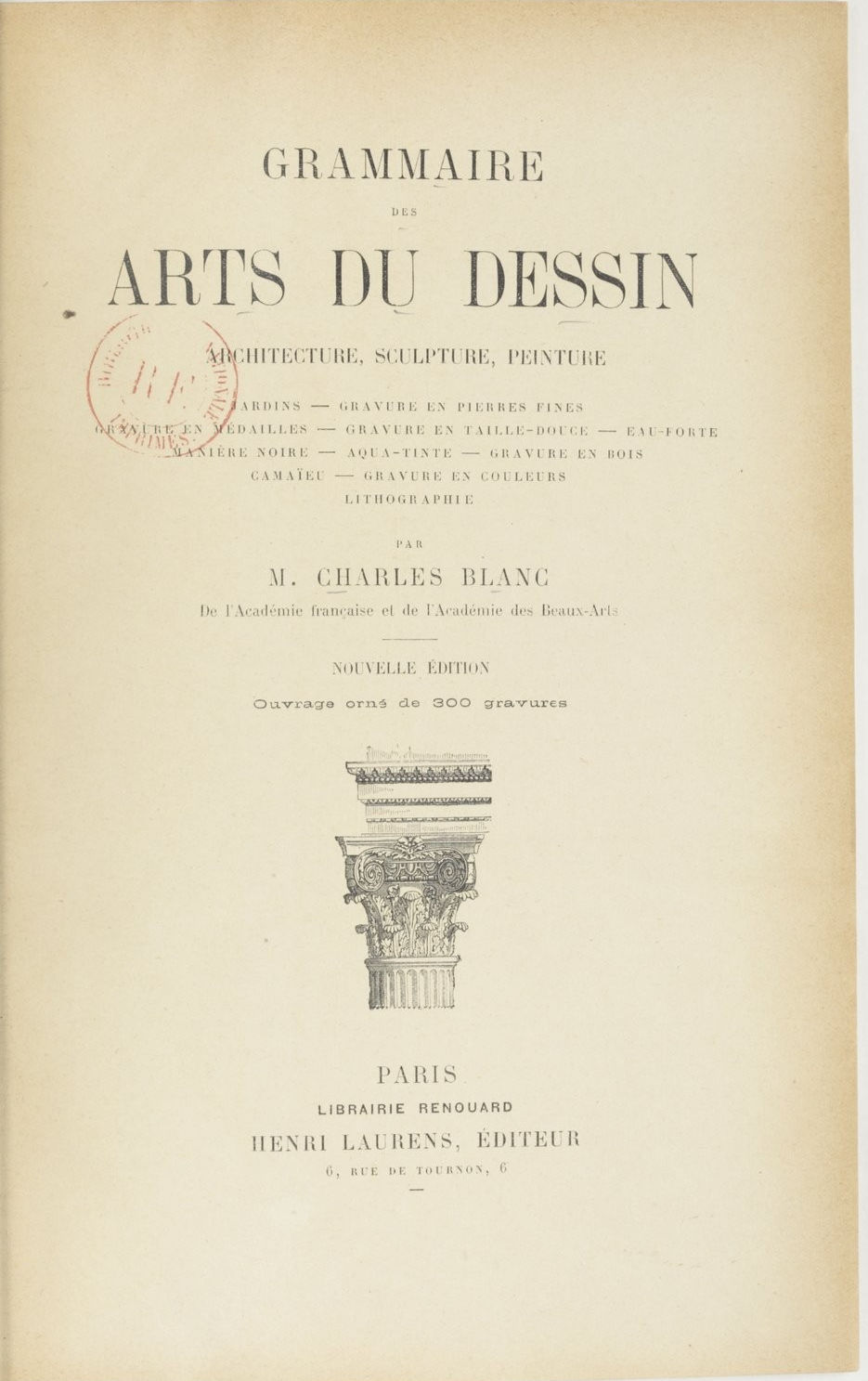

Colour science made a breakthrough thanks to the research of the chemist and director of the Gobelins Tapestry Works, Eugène Chevreul, whose work—published under the title abbreviated here as De la loi du contraste simultané des couleurs—was very widely disseminated through Charles Blanc’s Grammaire des arts du dessin. Chevreul observed and explained that two hues placed in immediate proximity inevitably influenced each other; he described the mechanisms and how to master them.
These laws of optics posed a challenge to the artist by effectively painting over their brushstrokes: since colours optically had the power to superimpose their complementary one onto their borders, it made controlling contours and the result of optical mixtures difficult.
To illustrate this phenomenon, Chevreul used the example of the shifting nuances observed from a distance on a cashmere shawl, while Charles Blanc analysed certain paintings by Eugène Delacroix.

In Women of Algiers, Blanc explained, Delacroix had placed a scattering of small green touches over a pinkish garment, producing a chromatic vibration of extreme finesse that the brush alone could not formulate in a static manner.
Similarly, his decorations for the dome of the Palais du Luxembourg manage to illuminate a complexion through the application of pink touches covered with green hatchings, even though the space receives no direct light. The reason is as follows: the green, in contact with the adjacent pink, neutralises itself to form a fresh and mixed tone that is perceptible only to the spectator positioned at a certain distance.
The eye then acts as a tool for chromatic fusion, restoring the balance of white light by completing the missing coloured beams to soothe ocular fatigue, according to Blanc.
Charles Blanc suggested taking control of this optical recolouration by stippling surfaces using small dots or stars—a technique that encourages the appearance of a third hue, indefinable and impossible to prepare in advance on a palette, which he called "optical mixing" and whose delicate luminosity satisfied him.
But in reality, there was indeed a way to control this third hue.
The Trap of Colour-Matter
While the visual effects of optical mixing were minutely described by Charles Blanc and Chevreul, their predictions regarding the hues resulting from these juxtapositions proved technically erroneous.
This inaccuracy originated in an error initiated several decades earlier by Isaac Newton, who confused the properties of colour-light with those of colour-matter.
Following this reasoning, Isaac Newton asserted that it was possible to recompose pure white using material pigments. Chevreul adhered to this flawed logic, assuming that the assembly of the three traditional primaries used in painting would allow for the perfect reconstitution of light…
...But the reality is quite different; it is well known that the opposite occurs, with painters speaking of "broken tones" and "grays." Mixing yellow and violet, or blue and orange—that is, a primary and the combination of the other two—does not create white paint.
Ogden N. Rood’s Scientific Revolution and the Advent of Divisionism

One must wait for the experiments of the physicist Ogden N. Rood, continuing the work of Young and Helmholtz, for colour theory to advance: he demonstrated that the hues resulting from the mixing of light rays and the mixing of pigment materials obey opposite physical rules, and that generally, the mixing of light is more likely to lead to luminous hues (the probability of additive synthesis is greater, to use modern terminology).
The primary colours of matter are yellow, red, and blue, and are not identical to the spectral primaries: red, green, and blue.

Through optical devices, he proved that the superposition of coloured filters of the three spectral primaries functions according to the principle of additive synthesis—an optical phenomenon that exalts luminosity by combining pure waves—whereas the grinding of these same coloured glasses and the mixing of their powder induces a process of subtraction and absorption that extinguishes the brilliance of the colour and tends toward black-grey.
But still unable to correctly predict the impact of luminous or retinal mixtures resulting from the blending and juxtaposition of tones, he advised SEPARATING them.
To do this, he conducted an experiment. He placed two tones, say red and blue, at the edges of a disc, and at the center, the result of these two hues materially mixed: violet. He set this disc in rotation. What happened? The hue at the center remained unchanged, but those at the edge mixed on the retina to form a violet...
…Except that this violet was much more luminous than the one at the center, and to match that violet resulting from a material mixture, he had to add black to the hues at the edge.
He rightly deduced that the palette mixture darkens the result.
Seurat Learned the Lesson
Georges Seurat, passionate about theories, who shut himself away for months to read, understand, and put into practice this treatise combined with Chevreul’s laws of complementaries, invented divisionism with Signac as it appears in A Sunday Afternoon on the Island of La Grande Jatte.

He assimilated the distinction between spectral and pigment primaries, realising the consequences of the absorbent nature of the traditional palette: he would no longer mix on his palette and opted for a strict division of pure tones, anticipating the resulting retinal mixture.
Divisionism was born, resting on the strict juxtaposition of small touches of pure colours. It was up to the human eye to perform the mixtures, which would result in greater luminosity.
The Irony of Rood’s Judgment
During a visit to the gallery of the dealer Paul Durand-Ruel, Rood was confronted with the works of Monet, Pissarro, and the Neo-Impressionists.
Appalled by the pictorial interpretation that had been made of his work, he declared he was horrified, telling his son that he regretted even the publication of his book.
The scientist who had discovered the laws of retinal mixing and the existence of primary luminous colours distinct from pigment primaries, as well as the absorption phenomena of mixtures, was not an avant-gardist when it came to aesthetics.
This blog relies on the primary source anthology sheets provided by Art d’Histoire Académie:
Plus all those inserted as links in the blog above
You can also view our traditional, free-access videos:
The Art d’Histoire Académie platform specialises in primary sources and digitised archives covering the artistic period from 1850 to 1910.
It offers clear, structured interactive videos accompanied by a library of over a thousand anthology sheets, comprising 10,000 explained and contextualised primary sources that can be viewed in their original format.
Whether you are preparing for an exam, a lecture, a guided tour, a conference, an exhibition, or a publication, Art d’Histoire Académie is here to support you. The labyrinth of archives simply becomes what it ought to be for any passionate researcher: a source of inspiration and a space for fulfilment.


