
The Great Bazaar: When the Noble Paris Salon Became a place to shop

For centuries, the Paris Salon was a temple. It was the sanctuary of the "Liberal Arts," where painting was displayed to glorify the nation and educate the soul. But in the 19th century, this temple was invaded by a new, vulgar force: the market.
By the 1880s, the prestigious exhibition had transformed into what critics horrifiedly called a "bazaar." It was no longer about art for art's sake; it was about art for business's sake. The walls of the Palais de l'Industrie were not just displaying masterpieces; they were selling commodities to a bourgeois public hungry for decoration.
The Shopkeeper's Invasion
The rot, according to the purists, began early. The "Liberal Arts" were defined by their freedom from financial necessity; a painter was not supposed to be a merchant. However, as the State could not support every artist, the Salon inevitably became a marketplace.
As early as the 1830s, critics like Ingres were lamenting that the Louvre had been transformed into a "shop of paintings for sale." By 1853, the Academy had to issue threats, forbidding members from keeping shops or putting up signs. But the tide was unstoppable. The Salon catalogue itself began to look less like a museum guide and more like a catalogue from Le Bon Marché, financed by advertisements for products like "Eau de Brahms" (for obesity). The commodification of art was underway.
The Revolution of 1879: The Department Store Model
The turning point came in 1879. The State, overwhelmed by the sheer volume of works (rising from 1,000 to over 7,000 in a few decades), handed the organization of the Salon over to the artists themselves. This led to a radical restructuring that mirrored the rise of the department store.
Previously, works were hung alphabetically. But under the new regime, paintings were organized into "sympathetic groupings" by style or theme. While this seemed logical, critics argued it turned the Salon into a series of retail departments. Art was compartmentalized and cataloged like merchandise—landscapes here, portraits there—eroding the traditional Hierarchy of Genres.
The Electric Nightmare
Even more shocking to the old guard was the introduction of electric lighting. In 1879, the installation of electric lamps allowed the Salon to stay open late into the evening.
This changed the audience entirely. The Salon became an evening "amusement," a leisure space competing with the music halls. Critics like Jules Clarétie were dismayed, noting that attendance skyrocketed to 683,000 visitors.
He sarcastically remarked that the Salon now only lacked music to rival the Folies-Bergère, or perhaps it should just be turned into a "Skating-Salon." The electrification symbolized the ultimate victory of the crowd over the connoisseur.
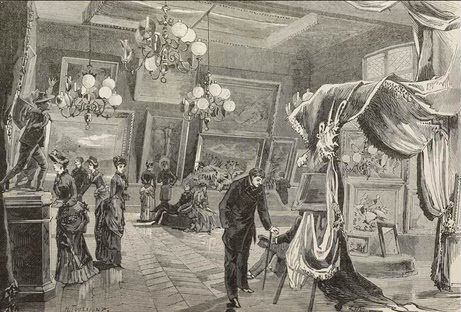
The Failed Counter-Attack: The Triennale of 1883
In a desperate attempt to restore dignity, a "Triennale Salon" was organized in 1883. It was designed to be the "anti-bazaar," a selective exhibition of "pictures to see" rather than "pictures to sell."
The organizers tried to make it look elite, decorating the space with tapestries and giving the paintings plenty of room, unlike the crowded walls of the regular Salon. The result was a cruel irony. By trying to look sophisticated, the Triennale ended up resembling a "private gallery" or a bourgeois showroom. It mimicked the commercial luxury of dealers like Georges Petit. The public found it boring, and the event was a financial disaster, proving that the age of the "Salon-Museum" was dead. The age of the "Salon-Bazaar" had won.
This blog is based on the anthologies of primary sources edited by Art d'Histoire Academy.
Find the complete academic references in:
We believe in making academic art history accessible and reliable for all.
The Art d’Histoire Academy platform specialises in primary sources and digitised archives, covering French art history from 1850 to 1910.
It offers clear, structured, interactive videos, as well as a library of over a thousand articles that explain and contextualise primary sources.
Whether you are preparing for an exam, exhibition or publication, the Art d’Histoire Academy will support you.


