
The Complex Functioning of the Jury of the Paris Salon, 1831-1881
- Art d'Histoire
- May 28
- 5 min read

For half a century, access to artistic recognition in France required an exhibition at the Salon.

However, to be exhibited there, one had to—unless exempted—first present their works to a jury, which either accepted or refused these submissions.
The history of the evolution of the jury's operating methods, and the ever-changing regulations of the Salon, provide the institutional framework of a system closed to innovation, often favouring modest repeaters of obsolete aesthetic values at the expense of innovators, including Corot and Millet, then Manet and the young Impressionists.
This complex system, in perpetual reformulation yet never fully satisfying, is symptomatic of an end of a reign. A brief explanation is necessary.
Academicians are the Sole Members of the Jury until 1847
The Salon jury is the commission responsible for accepting or rejecting the works to be exhibited at the Salon.
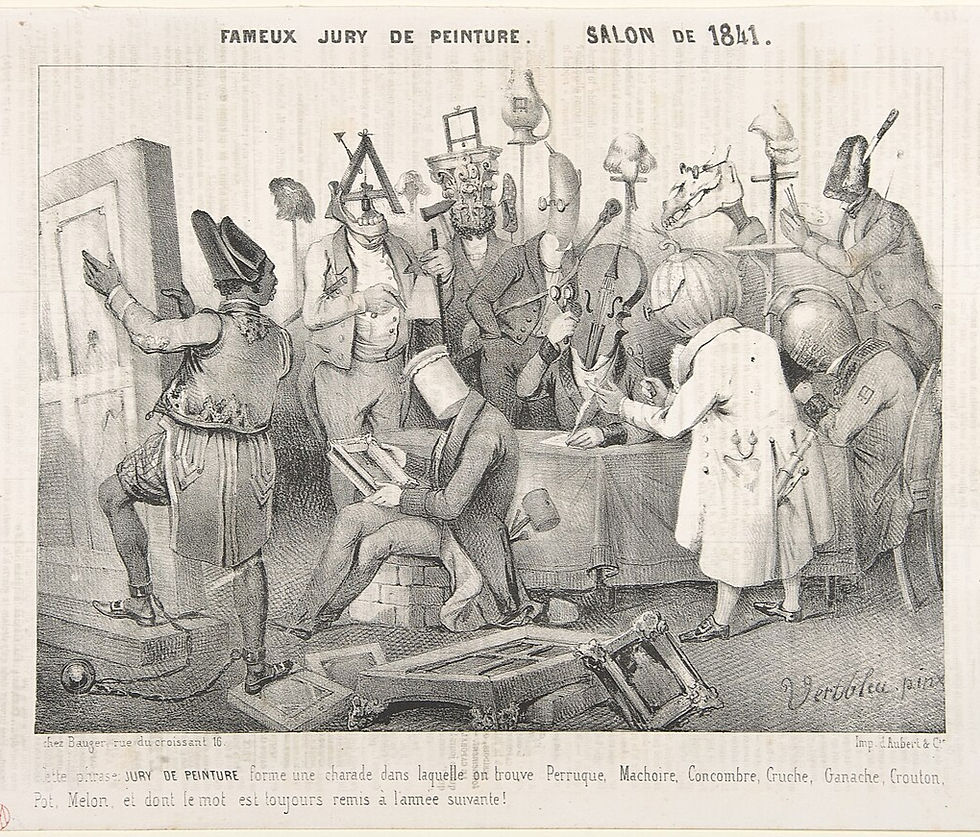
Between 1831 and 1847, the Academy of Fine Arts exercised an absolute monopoly over the selection of works, as only its members could participate in the jury.
From year to year, two tendencies clashed: the most conservative, which tried to slow the progress of the most innovative artists—those less respectful of the famous "line," including Delacroix, Flandrin, Corot, Daubigny, Diaz, Dupré, and later Courbet.
This conflict, known as the "war of the schools," was all the more exacerbated because, since 1796, it had become customary to note the professor's name under the heading "pupil of" printed in the famous Salon catalog. An academician on the jury would tend to favor his own pupil or that of another professor of his persuasion.
The system generated strong frustrations, and solutions were sought. Among them was the proposal by the sculptor David d'Angers, formulated in 1838: to organise a permanent salon where works would be renewed every six months, effectively allowing for twice as many works to be exhibited, accompanied by a decennial exhibition for the most exceptional ones.
His objective was to avoid the constant dilemma between a selection that was too severe and the risk of overcrowding if one were too indulgent.
But nothing happened… until 1848, when, having toppled the monarchy, there was also hope of overturning the jury system, a vestige of a condemned aristocratic system.
The Rupture and Experiment of 1848
The advent of the Second Republic indeed upset the established order and reconnected with the more liberal principles of the Revolution of 1789.
Under the impetus of the Ministry of the Interior directed by Ledru-Rollin, the selection process by examination was abolished for the year 1848. A jury, exceptionally elected by all participants, retained only a logistical mission for the hanging of the works.
The decision was generous but counter-productive: admission without restriction led to a doubling of the number of works exhibited, totaling more than five thousand pieces.
One understands why Gustave Courbet grumbled—he who had been selected by the Salon jury in 1848. Now that the revolutionaries had opened the door to all those who had previously been refused, his canvases were drowned in the crowd, and his works were invisible!
The visual chaos and disparities in quality forced the authorities to quickly re-establish a jury the following year.
The Quest for Balance: 1849-1881
The restoration of a selection jury in 1849 initiated a long period of trial and error and administrative readjustments—a true headache for artists and historians alike.
Every year, until 1881, the composition of the jury fluctuated, combining appointments by the administration of fine arts (the government), by a college of artists whose own composition varied, and by the Academy, as it was before 1848.
To satisfy all sides, reliance was placed mainly on successive alterations to the jury's composition: in 1849, it was the artists who had already exhibited (except in 1848) who elected their representatives to the jury; in 1852, an innovation brought a mixed system, partly elected by the artists and partly by the administration. Yet, against all expectations, in 1857, while the jury was once again entirely composed of members of the Academy, the indulgence shown was unprecedented.
Conversely, the application of a strict three-tier distribution (Academy, administration, and prize-winning artists) during the year of the Universal Exhibition in 1867 resulted in a record level of severity and an exceptionally high number of rejections. The young Monet, Bazille, Sisley, Renoir, and Pissarro were all out of the running.
From 1868 onwards, the Academy would no longer participate in the jury; the Fine Arts administration and the artists were solely responsible.
To this first regime of modulation, another was added: the number of submissions per artist, which, if too high, led to a bottleneck at the jury level, as their time was not infinite.
As an example, in 1863, more than nine thousand works were received for examination; the time allotted per painting or sculpture then fell to some forty-five seconds; the pace was infernal, and the quality of judgment erratic by the end of the session. It was then preferred to limit submissions to at most two or three works per artist.
The frequency was another adjustable parameter. From 1864, there was a return to an annual edition, which had been abandoned since 1853; that year, a second Salon des Refusés was also organized. Even so, the system still failed to give satisfaction.
Each relaxation of the rules and each excess of indulgence had consequences that were sometimes detrimental to quantity or quality. The balance was difficult to achieve.
The System of Rewards: Hierarchy and Exemptions
A system of rewards, established in 1848, accompanied every Salon. It too participated in the mechanism of relieving pressure on the jury. It too varied from year to year.
Initially, there were 1st, 2nd, and 3rd class medals, joined by rewards and other prizes depending on the version of the annual regulations.
From this stemmed the exemption system, indicated by the initials "EX."
At first reserved only for medalists—meaning works the jury would not have to evaluate—the system gradually expanded to include winners of the Prix de Rome, members of the Institut, then recipients of honorable mentions and more modest rewards.
Once again, this automatic waiver mechanism quickly generated bitterness in some; accusations of complacency multiplied.
Toward Final Emancipation 1879-1881
In 1879, the Under-Secretary of State for Fine Arts, Edmond Turquet, proceeded with a vast democratisation of the electoral system: all artists who had exhibited over the last three years were admitted to participate in the election of jurors—more than 2,000, compared to a college of 700 previously; their elected representatives were added to those appointed by the administration.

The following year, a final invention was attempted: by imposing a numerus clausus within the jurors representing the minor genres, it was expected that they would defend their colleagues; this was an indirect way of revaluing still-life, animal, and landscape painters.
To no avail; dissatisfaction continued to growl. Despite the successive overhauls, the conflicts surrounding the jury system and its exemptions had run their course.
The State decided to disengage. In 1881, the entire responsibility for the organisation was transferred to the Société des Artistes Français, closing a long chapter of institutional history whose origins dated back to the year 1673.
This blog relies on the primary source anthology sheets provided by Art d’Histoire Académie:
Plus all those inserted as links in the blog above
You can also view our traditional, free-access videos:
The Art d’Histoire Académie platform specialises in primary sources and digitised archives covering the artistic period from 1850 to 1910.
It offers clear, structured interactive videos accompanied by a library of over a thousand anthology sheets, comprising 10,000 explained and contextualised primary sources that can be viewed in their original format.
Whether you are preparing for an exam, a lecture, a guided tour, a conference, an exhibition, or a publication, Art d’Histoire Académie is here to support you. The labyrinth of archives simply becomes what it ought to be for any passionate researcher: a source of inspiration and a space for fulfilment.


