
Le Tambourin: A Montmartre Tavern Transformed into a Laboratory for the Parisian Avant-Garde?

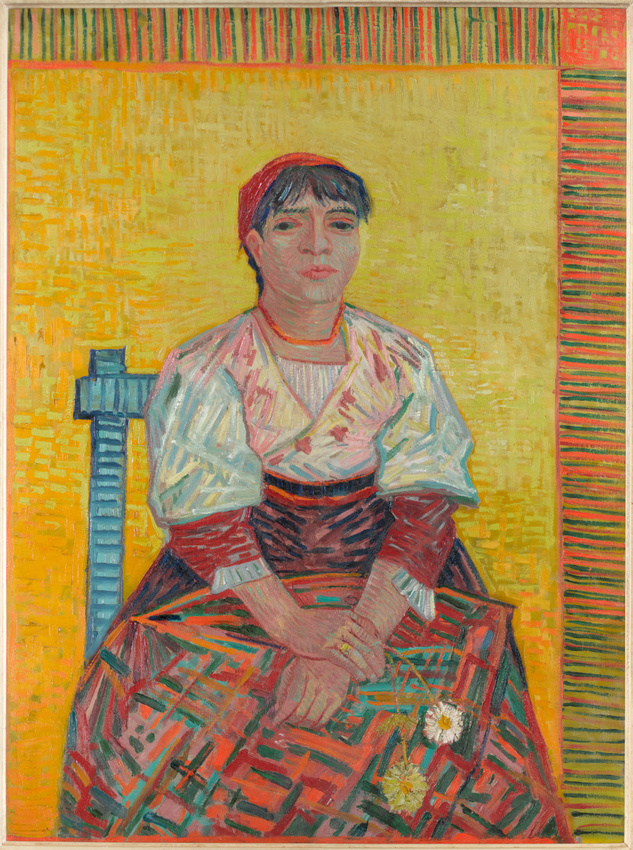
In the spring of 1885, a café on the Boulevard de Clichy run by a certain Agostina Segatori was to transform itself for a time into a gallery of a very particular kind.
A Decor on the Theme of the Tambourine
The name alone is enough to describe the inn, which displayed an unusual decoration centered around that simple and popular musical instrument, the tambourine, presented in all its forms.

The sign, the porcelain plates, and even the glass light fixtures adopted the motif; as for the furniture, it was partly made from old tambourines salvaged by the owner. They can be found in the form of tables and stools in two paintings by Vincent van Gogh, Agostina Segatori in the Café du Tambourin and Basket of Pansies from 1887.
Other tambourines decorated the room, sometimes bearing an artist's drawing, others a few lines by poets.

This was not a first, as the donkey skin of tambourines had already inspired many painters, including Édouard Manet with Toreador Saluting or Ballet Shoes at the end of the 1870s; Paul Gauguin also tried his hand at it in 1886 with Fruits, Tambourine Decoration, and it was Henri de Toulouse-Lautrec's turn two years later to paint his At the Circus: Bareback Rider on a tambourine.
Hot Meals in Exchange for Floral Paintings
Much like at the Grand Bouillon-Restaurant du Chalet, Vincent van Gogh had found free meals and, in exchange, provided a regular production of canvases, mainly floral studies.
Émile Bernard recalls that Van Gogh's creative frenzy had eventually transformed the dining room into an artificial garden, his flowers literally lining the walls. As for Ambroise Vollard, he reports having encountered the Dutch painter there as he was hanging one of his Sunflowers canvases.
However, since the painter considered this display a simple loan, once their friendly or romantic relationship was over, he expected the canvases to be returned to him, but the owner disposed of them otherwise.
Upon the liquidation of the establishment, all of Vincent's paintings were auctioned in lots of ten and sold for derisory amounts, as was the rest of the furniture.
Van Gogh's Japanese Exhibition
From its inauguration, the room had served as a gallery for painters, and thus Édouard Dantan or even Jean-Léon Gérôme had exhibited there.
At the beginning of 1887, Vincent organised an exhibition there of Japanese prints acquired in large numbers from the dealer Bing.

The venture was a disaster on a financial level, but Vincent took pleasure in remembering that it was the opportunity for his friends of the "petit boulevard," Louis Anquetin and Émile Bernard, to discover a new imagery that was to contribute greatly to the development of their technique known as Cloisonnism.
Presumably, the prints had been pinned to the walls, as he had made a habit of doing since Antwerp and as they appear in the background of the portraits he made of Segatori and Père Tanguy.
This blog relies on the primary source anthology sheets provided by Art d’Histoire Académie:
Plus all those inserted as links in the blog above.
You can also view our traditional, free-access videos:
The Art d’Histoire Académie platform specialises in primary sources and digitised archives covering the artistic period from 1850 to 1910.
It offers clear, structured interactive videos accompanied by a library of over a thousand anthology sheets, comprising 10,000 explained and contextualised primary sources that can be viewed in their original format.
Whether you are preparing for an exam, a lecture, a guided tour, a conference, an exhibition, or a publication, Art d’Histoire Académie is here to support you. The labyrinth of archives simply becomes what it ought to be for any passionate researcher: a source of inspiration and a space for fulfilment.


