
Some early Anecdotes from Claude Monet's early years
- Art d'Histoire
- Feb 18
- 4 min read

In the history of art, names carry weight, but in 1866, a single vowel caused a misunderstanding that nearly derailed a friendship before it began. Édouard Manet, already established as a controversial figure (with Luncheon the Grass exhibited in 1863 and Olympia in 1865), walked into the Salon on the day of the vernissage to a chorus of cheers. Friends and strangers alike shook his hand, congratulating him on his "excellent" painting. Elated by this rare warmth from the public, Manet’s ego swelled, only to be punctured moments later when he realised the praise was for a painting that was not his.
The Name Mix-Up

The work in question was The Woman in the Green Dress, painted by a young, unknown artist named Claude Monet. The public, confusing the two names, had credited the newcomer's success to the well-known painter. Manet was furious. Upon running into a group of artists including Frédéric Bazille, he vented his spleen, declaring that he had been the victim of a name mix-up that felt like a "hoax." He complained bitterly that he was only being complimented on a painting that wasn't his, a stroke of genius achieved by someone else. He refused to meet the young Monet, holding a grudge against the "impostor" that would last until 1869.
The Millionaire Caricaturist

Before becoming the master of Impressionism, Monet was a schoolboy with a knack for irreverence. In his youth in Le Havre, he decorated the margins of his notebooks not with landscapes, but with grotesque distortions of his teachers. These drawings became so popular that he began selling them to local notables. Reflecting later on the usefulness of caricatures, Monet mused that if he had continued asking for ten or twenty francs per portrait, he would be a millionaire. This early commercial success gave him a false sense of security, leading him to proudly tell his parents he could do without their financial support, a boast he would soon regret.
The Trench and the Master
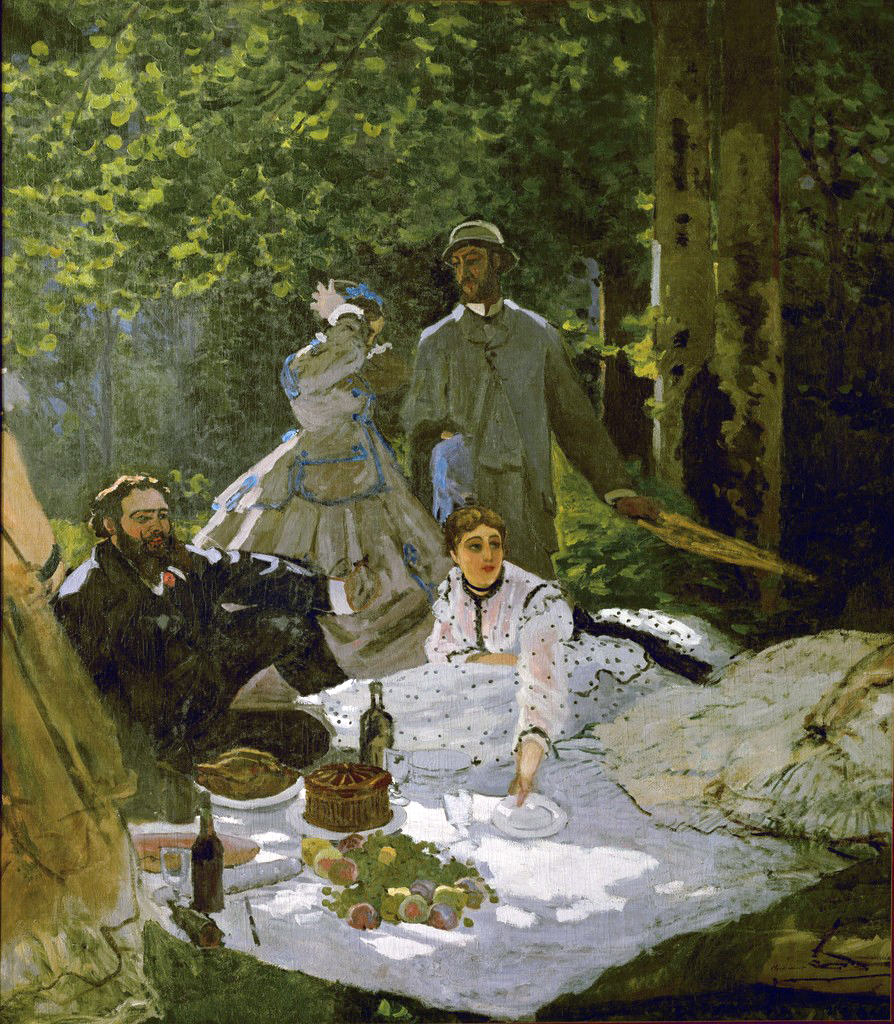
Monet’s transition to serious painting was marked by ambition and the mentorship of Gustave Courbet. While painting Women in the Garden, Monet insisted on working entirely en plein air. To manage the large canvas, he had a trench dug in his garden and used a pulley system to lower the painting so he could reach the upper sections without losing his view of the subject. Courbet, visiting the young artist, watched this spectacle with amusement but also respect.
Their relationship had been cemented earlier when Courbet advised Monet on his monumental Luncheon on the Grass. Courbet had come to see the "young man who painted something other than angels," a nod to his own realist philosophy.However, Courbet’s advice to modify the painting did not solve Monet’s problems, and he abandoned the work in a damp cellar. When he finally retrieved it, the canvas had been ruined by mould, forcing him to cut it up, leaving only the fragments of a masterpiece that once rivalled Manet’s own scandalous works.
Desperation and Survival
Despite Courbet’s encouragement, the late 1860s were a period of crushing poverty for Monet. His family, scandalised by his relationship with his pregnant mistress Camille Doncieux, cut him off. He was left begging for scraps. In a series of letters expressing an urgent need to paint, Monet pleaded with his friend Frédéric Bazille for money, asking for sums as small as fifty francs to buy food or materials.
The situation became so dire that in 1868, Monet wrote to Bazille claiming he had thrown himself into the water in a suicide attempt, though contemporaries like his stepson later doubted the story, noting Monet was too good a swimmer to drown. While Bazille did what he could, purchasing Women in the Garden in monthly instalments of fifty francs, Monet was constantly pursued by creditors, at one point being thrown out of an inn "naked as a worm" with his wife and child.
The London Exile
The outbreak of the Franco-Prussian War in 1870 forced the circle of friends to scatter. While Bazille marched to his death on the battlefield, Monet, Pissarro, and Daubigny fled across the channel. This London exile was a time of displacement but also of networking. Daubigny, already successful in England, introduced Monet to the dealer Paul Durand-Ruel, a meeting that would eventually secure his future.
Back in France, the war took a toll on their art. Pissarro returned to Louveciennes to find his studio ransacked by Prussian soldiers. Hundreds of paintings, including those entrusted to him by Monet, had been destroyed or used by the butchers as aprons to protect their uniforms from blood, a grim reminder of the fragility of the art they had sacrificed so much to create.
This blog is based on the anthologies of primary sources edited by Art d'Histoire Academy. The complete academic references are available in the following publication:
There are four freely available videos on the Art d'Histoire website dedicated to Impressionism:
We believe in making academic art history accessible and reliable for all. The Art d’Histoire Academy platform specialises in primary sources and digitised archives, covering French art history from 1850 to 1910.
It offers clear, structured, interactive videos, as well as a library of over a thousand articles that explain and contextualise primary sources.
Whether you are preparing for an exam, exhibition or publication, the Art d’Histoire Academy will support you.


