
How Democracy and "Eclecticism" Killed History Painting and Paved the Way to Modernism

In the mid-19th century, a silent but brutal war was waged on the walls of the Paris Salons. It was not a battle fought with swords, but with genres, where the elite of its hirerachy was overturned by its base. On one side stood History Painting, the noble, intellectual art of the monarchy and the Church, designed to elevate the soul and glorify the Nation. On the other rose the "minor genres"—landscapes, portraits, and scenes of daily life—which represented the rising tide of democracy, individualism, and the bourgeoisie.
The collapse of the old order — the supremacy of history painting — was not just due to a change in fashion. It was the result of deep-rooted political and societal changes that led to its decline. As the critic Jules-Antoine Castagnary observed in 1857, the decline of theocracy and monarchy inevitably led to the decline of the art that served them. The 'Grand Art' was dying out, making way for a new reality in which the individual took precedence over the state, thus creating an environment in which modernity could flourish.
The Sacred Duty of Liberal Arts
To understand the magnitude of this shift, one must remember what art used to be. Since the 17th century, Ennobling Fine Arts was a state affair. As Louis XVI defined it in 1777, the function of the Liberal Arts was to "depict the glories of the nation" and preserve the memory of "virtuous deeds."
Jean-Auguste-Dominique Ingres was the last great defender of this faith in the 19th. For him, art was a "catechism," a rigid set of rules derived from Raphael and the Greeks.

He believed that painting should ignore the ugly accidents of reality to focus on the eternal "True and Beautiful." But by the 1850s, Ingres was a relic. His art was seen by critics like Nadar as a vestige of a "royalist and clerical past," leaving the aftertaste of an "invalid's handkerchief."
The Trap of "Eclecticism"
If the disapperance of the royalty and the decline of faith created a long term trend, the death blow to the hierarchy of genre came from a government strategy known as Eclecticism. The Second Empire, seeking to maintain peace, tried to rally all political forces—bourgeois, Catholic, monarchist, and working-class—under one banner.
In the arts, this meant satisfying everyone. The regime ratified all existing trends, effectively declaring that all genres were equal as long as they supported the Empire. By refusing to choose a side, the state destroyed the hierarchy of genres. Great Art was no longer defined by its intellectual nobility, but by the political faction it courted.
The Humiliation of 1855: The Medal Scandal
The tension exploded during the 1855 World Fair. Ingres expected a coronation; he received a compromise. To satisfy the policy of eclecticism, the jury awarded not one, but ten Grand Medals of Honor.


Ingres was furious. In a letter to his friend Marcotte d’Argenteuil, he unleashed his rage at finding himself on the same level as Horace Vernet, whom he called the "apostle of ugliness" and a "painter of puppets." He refused to accept the medal, deeply offended to stand alongside a man he considered a mere entertainer. For Ingres, this moment marked the death of History Painting as a supreme genre. The "Prince of Painters" was no longer the idealist Ingres, but the populist Vernet.
The "Apostle of Ugliness": The Rise of the Hybrid
Who was this Horace Vernet, the man who drove Ingres to despair? He was the star of a new, bastardized category known as Historical Genre Painting, a genre that Delaroche had mastered.
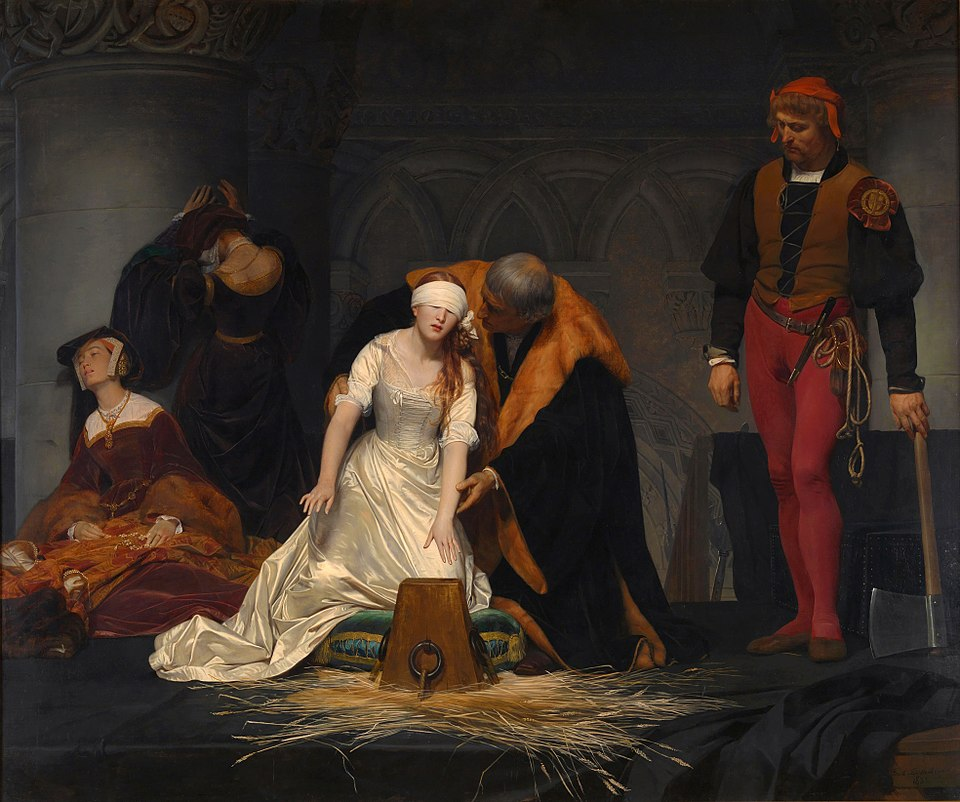
Vernet painted great battles and historical events, but he stripped them of their tragic, frozen beauty. Instead of the "unity of action" required by classical rules, Vernet offered what critics called "gigantic narratives" strung together by anecdotes. His eye was compared to the lens of a daguerreotype, capturing the muddy, chaotic reality of war rather than its poetic soul.
Critics lamented that Vernet produced "serial painted documentaries" rather than art. Yet, the public adored him. He represented the "middle ground"—neither the highbrow intellectualism of history painting nor the lowbrow simplicity of genre painting. He was the perfect artist for an age of transition.
1867: A Pretty but Dead Language

The final nail in the coffin came in January 1867 with the death of Ingres. Théophile Gautier wrote that Ingres had been the "last link" holding back the "anarchy" of modern taste. With him gone, the dam broke.
History painting became a "dead language," practiced by institutions but ignored by the living pulse of society. The Republican state tried to keep it alive through public commissions for the Panthéon, awarding contracts to academic painters like Alexandre Cabanel.
However, the results were often mocked. Critics pointed out the absurdity of the "academic technique" applied to modern subjects, noting that painting modern costumes on bodies originally sketched as nudes resulted in figures that looked impossibly "stiff"or false.
The "new social strata" preferred art that reflected their own lives: landscapes, portraits, and the immediate reality of the streets. The age of the "School of Athens" was over; the age of the Modern Painter had begun.
This blog is based on the anthology sheets of primary sources offered by Art d'Histoire Academy.
Find the complete documents analyzed in this article:
Access the Art d'Histoire video channel, which offers 64 free video conferences on 19th-century European art. The videos are available in both French and English.
The Art d’Histoire Academy platform specializes in primary sources and digitized archives covering the artistic period from 1850 to 1910.
It offers clear and structured interactive videos accompanied by a library of over a thousand anthology sheets, composed of explained and contextualized primary sources.
The maze of archives simply becomes what it should be for every passionate researcher: a space for inspiration and realization.


