
Claude Monet and His Collection of Japanese Prints

While Monet may not have been the very first to "discover" the aesthetic value of Japanese prints, he was a major collector of them.
Monet as Discoverer of Prints: A Biased Narrative
At the end of his life, according to accounts gathered by the author Marc Elder, the painter claimed to have acquired his first prints from a second-hand dealer in Le Havre in 1856.
This dealer of exotic curiosities, ranging from parrots to coconuts, supposedly also stocked prints that were used as packaging for objects coming from Holland—France having not yet signed a commercial treaty with Japan; the treaty would be signed in 1858. Whether this episode is accurate or not, at that date, Monet, aged only sixteen, had not yet assimilated the Japanese aesthetic, which had no influence on his practice at the time.
It is most likely that his discovery of Japanese prints took place in the spring or summer of 1871.
On his way back from London, where he had lived in exile during the Franco-Prussian War, Monet spent a few days in the Dutch town of Zaandam.
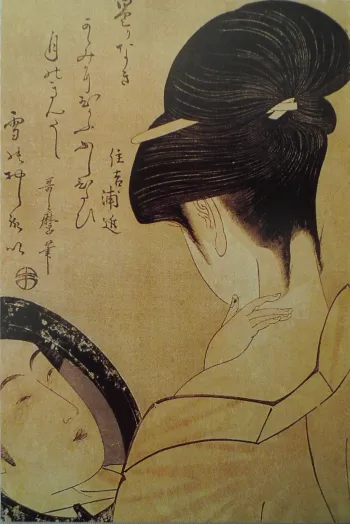
According to Jean-Claude Hoschedé, Gustave Geffroy, and the writer Octave Mirbeau, a grocer in the village of Zaandam wrapped his goods in the famous prints. When Monet set eyes on them, he was captivated and bought the pile of prints from the perplexed merchant. In the lot were magnificent Korins, depicting herds of deer, and women at their toilet by Utamaro…
Monet's Collection
This first purchase marked the beginning of a magnificent collection.
Today, this collection represents some two hundred and thirty-one engravings, but there were exchanges, new acquisitions, resales, and certainly losses.
Monet exchanged his own canvases for prints owned by the entrepreneur Kojiro Matsukata or the dealer Tadamasa Hayashi. With Maurice Joyant, he exchanged prints, seeking to complete his series, notably floral plates by Hokusai depicting peonies, morning glories, or chrysanthemums.
Singular Choices
His interest focused on about forty masters.
Monet preferred prints from the eighteenth and nineteenth centuries; he owned no very old prints, nor shunga—erotic scenes—nor ôkubi-e, portraits of actors with facial expressions he likely judged too grimacing.
On the other hand, he assembled iconic pieces signed by Utamaro, such as The Makeup, or by Hiroshige, including Night View of Saruwaka-machi, and nine proofs from the first printing by the publisher Nishimuraya Eijudō of Hokusai's Thirty-six Views of Mount Fuji, recognisable by the use of a blue outline; among which is the famous Under the Wave off Kanagawa. It is known that Edmond de Goncourt would write that this series was at the heart of Impressionism.

The collection includes a limited number of kachō-e—representations of flora and fauna—motifs that resonate with his own choices of subject matter.
More surprising is the significant presence of uki-e, Japanese images experimenting with the rules of Western linear perspective, as well as yokohama-e by Yoshitora, illustrating the daily lives of foreigners in trading ports—a perhaps more anecdotal choice.
The Print as Decor
At Giverny, the prints were partly stored in portfolios where they remained for a long time after his death, and have since been restored and reinstalled in the Giverny house-museum.
But Monet lived literally surrounded by these prints, protected by glass. They were hung on the walls of the small blue salon, in the dining room with its yellow woodwork—the tones of the prints echoing those of the room—in the vestibule, in the stairs leading to the studio, and on the door panels…
Monet's garden was also partly under Japanese influence. We learn that, through Gustave Caillebotte, he obtained Japanese plant bulbs, not to mention his small Japanese bridge installed over the pond.
This blog relies on the primary source anthology sheets provided by Art d’Histoire Académie:
Plus all those inserted as links in the blog above.
You can also view our traditional, free-access videos:
The Art d’Histoire Académie platform specialises in primary sources and digitised archives covering the artistic period from 1850 to 1910.
It offers clear, structured interactive videos accompanied by a library of over a thousand anthology sheets, comprising 10,000 explained and contextualised primary sources that can be viewed in their original format.
Whether you are preparing for an exam, a lecture, a guided tour, a conference, an exhibition, or a publication, Art d’Histoire Académie is here to support you. The labyrinth of archives simply becomes what it ought to be for any passionate researcher: a source of inspiration and a space for fulfilment.


