
Keys to Baudelaire's Modernism : Mud into Gold, Ragpicking, and Realism
- Art d'Histoire
- Feb 20
- 4 min read

The history of 19th-century art is often framed as a clear-cut battle between the conservative establishment and the radical avant-garde. However, a closer inspection suggests that the avant-garde was far from being a coherent bloc. Conflicts occurred within the avant-garde itself, for instance between the self-proclaimed "Master of Realism," Gustave Courbet, and the "Prince of Clouds," Charles Baudelaire. Their relationship began in the bohemian squalor of a shared studio but ended in a bitter feud over the very definition of poetry and reality. For Baudelaire, art was not about a supposed useless and tiresome copying of the world, but about transmuting the filth of the city into the gold of poetry—an alchemy that required the eye of a ragpicker and the imagination of a dandy.
The Bed Sheet and the Spit

In 1855, Gustave Courbet placed Charles Baudelaire on the far right of his monumental canvas, The Painter’s Studio. To the casual observer, this suggests a united front, but the portrait was actually a recycling job. Courbet copied it from an earlier work dated 1848, which explains why the poet appears with very short hair, a style he wore years prior. This anachronism was convenient for the poet: it allowed Baudelaire to ask Courbet to remove his mistress, Jeanne Duval, who had originally stood beside him in 1848, no doubt fearing bourgeois disapproval.
Behind this painted unity lay a failed friendship. In their youth, between 1847 and 1849, they had shared a bohemian intimacy so deep that Courbet hosted the painter in his studio, piling up some old clothes in one corner to make an improvised bed for his companion. While one wrote poetry, the other painted. Yet, their temperaments clashed violently. Courbet, unrefined and aggressive, later claimed that writing poetry is dishonest, while Baudelaire eventually grew to detest the painter.
The animosity culminated in Courbet’s malicious plan to exhibit a painting titled The Hippocrene Source. The work depicted a naked woman spitting into a light basin where the great poets of the age—including Baudelaire, Lamartine, and Gautier—came to quench their thirst. Courbet gleefully told friends that the poets will be furious at this vision of them drinking spit. Fortunately for the poets, the canvas was destroyed in a studio accident, perhaps torn by Courbet's sister, leaving Courbet to lament the loss of his poisoned source.
The Dictionary of Nature

The core of their disagreement was philosophical. Courbet and his supporters advocated for a "Realism" that copied nature exactly. Baudelaire found this approach useless and tiresome because, to him, nature is ugly. In his 1859 critique, he argued that nature is merely a dictionary—a collection of disjointed words that the artist must rearrange to create meaning.
For Baudelaire, the true artist avoids borrowing the eyes of another man and instead relies on imagination, the queen of faculties. He believed that poetry was the most real thing, true only in another world created by the soul. While prosecutors condemned The Flowers of Evil for its gross and offensive realism—accusing him of painting everything including the hideous—Baudelaire privately accused the Realist school of bigotry and pedantry for trying to suppress the artist's personality in favour of a flat, positivist copy of the world.
The Alchemist of the Gutter
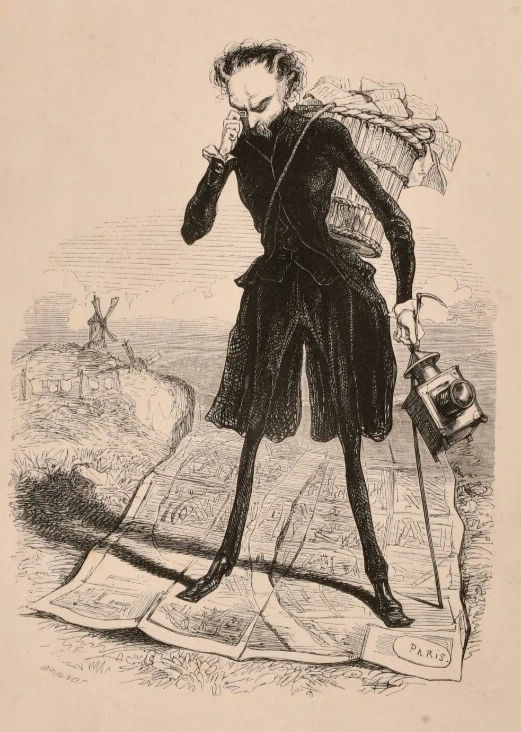
If Baudelaire rejected the copying of nature, he embraced the debris of the city. He conceptualised the modern artist through the trope of the literary ragpicker. Just as the ragpicker of Paris wandered the streets with a hook and a hood, collecting all the rubbish and excrement of the heart to sell to industry, the poet collected the ephemeral, the fugitive, the contingent elements of modern life.
This was not mere scavenging; it was alchemy. Baudelaire explicitly compared this process to the discovery of phosphorus by the alchemist Brandt, who extracted the luminous substance from urine. In his famous epilogue to The Flowers of Evil, Baudelaire addressed the city of Paris directly: "You gave me your mud and I’ve turned it into gold." The mud of Paris—the literal filth of the streets—became the raw material for the quintessence of art.
Heroism in the Mire

This new definition of art required new heroes. In the Salon of 1846, Baudelaire called for artists to abandon the ancient heroes like Achilles and Agamemnon. He argued that there are private subjects who are far more heroic, specifically pointing to the thousands of floating existences in the city's underground: criminals and kept girls.
He initially believed the watercolourist Constantin Guys (Monsieur G.) would be the painter of modern life capable of capturing this world. However, it was Édouard Manet who truly realised Baudelaire’s vision. Manet took the classical composition of a Titian nude and plunged it into the Parisian mire to create Olympia. Unlike academic painters who would produce a false, ambiguous and obscure work by copying the past, Manet captured the bearing, the glance, the smile of the modern courtesan. He became the perfect flâneur, a prince who everywhere rejoices in his incognito, setting up house in the heart of the multitude to distil the eternal from the transitory.
This blog is based on the anthologies of primary sources edited by Art d'Histoire Academy. Find the complete academic references in:
Enjoy our free videos :
We believe in making academic art history accessible and reliable for everyone.
The Art d’Histoire Academy platform specialises in primary sources and digitised archives, covering French art history from 1850 to 1910.
It offers clear, structured, interactive videos, as well as a library of over a thousand articles that explain and contextualise primary sources.
Whether you are preparing for an exam, exhibition or publication, the Art d’Histoire Academy will support you.


